

Mosmoxmosmox

Mosmox journal

In focus — user research.

A selection of publications grouped under the user research tag.

How to Identify the Core User Problem an App Should Solve

How to Identify the Core User Problem an App Should Solve

Teams often begin with “which features should we add?” Strong mobile products begin elsewhere: what specific problem is a person trying to solve, how often does it occur, and what happens if it remains unsolved? The answer shapes everything else — from the list of screens to the copy in the app store.

In our projects, the problem statement is the first artifact of discovery, and we do not move to design until every stakeholder has agreed on it. Below we explain how to get one and how to test it.

The problem must be observable

“Users need a more convenient app” is too general. A better description is a situation: someone spends 20 minutes re-entering data, cannot check an order status, or loses context after an interruption. That can be tested through interviews, analytics, and prototype research.

A sign of a well-framed problem is that it can be observed or measured without your product. If the problem exists only in the team’s deck, and in real life people neither notice it nor do anything about it, it is most likely not important enough.

Weak framingStrong framingHow to test
“Ordering delivery is inconvenient”“Office workers spend 10–15 minutes coordinating a group order in a chat”Interviews, screenshots of real chats
“Customers want better expense tracking”“Freelancers manually copy bank statements into a spreadsheet for tax reporting at the end of each quarter”Observing the process, timing it
“Patients need easy booking”“Patients call the clinic three times to reschedule because the line is busy”Call-center data, missed-call counts

How to separate symptoms from causes

  • Ask what users do without your product.
  • Find the exact point of delay or error.
  • Compare what people say with what they do.
  • Check whether the problem is important enough to change a habit.

A useful technique is the “five whys.” A user complains the app is “slow.” Why? Because the order list takes long to open. Why? Because it loads the entire history. Why does that matter? Because the person opens the list only to check the latest order. The real problem is not list performance but the absence of the latest order status on the home screen.

Another framework is Jobs to be Done, described by Clayton Christensen and co-authors in “Know Your Customers’ Jobs to Be Done” in Harvard Business Review: people “hire” a product to get a job done in specific circumstances. Asking “what job is our app hired to do?” often removes half of the unnecessary features.

In practice we combine both techniques with data. If the product already exists, we look at which funnel step loses the most people, then run 5–6 short interviews specifically with those who stopped at that step. Numbers show where the problem is; conversations show why it happens.

The Headspace case: a problem broader than a feature

The Headspace case on Android Developers shows that a problem can be broader than a single feature. In 2019, the company decided to expand its meditation app into fitness and wellness. Designers prepared prototypes of the new experience, but the existing Android architecture was not structured clearly enough to support the new capabilities.

The team estimated that building on the old code would take longer than a complete rewrite, so it froze development of the current version and focused on the rebuild: MVVM architecture, Android Jetpack libraries, Dagger and Hilt for dependency injection, and a full move to Kotlin. Test coverage rose from about 15% to 80%. The rewrite took eight months.

The results reported in the case: the Google Play rating rose from 3.56 to 4.7 between Q2 and Q4 2020, monthly active users grew 15% globally, and paid subscriber parity between platforms improved by 20%. The technical side is covered in a separate Android Developers Blog post.

The takeaway for problem framing: the real problem was not “missing fitness screens” but “the product cannot reliably deliver a new promise.” Had the team framed the task as adding features, it would have kept building on a foundation that could not carry the load.

From problem to hypothesis, step by step

  1. Collect raw data: 8–12 interviews, support tickets, store reviews, analytics from the existing product or competitors.
  2. Write out concrete cases as “who — what they were doing — where they got stuck — how it ended.”
  3. Group the cases by shared barrier and count how often each appears.
  4. Score each barrier by frequency, severity of consequences, and existing workarounds.
  5. Write the hypothesis: “For [audience] in [context], we will reduce [barrier] so people can achieve [outcome].”
  6. Define the success signal and a minimum experiment that tests it.

We described how to run such an experiment before development in how to validate a mobile app idea, and how to turn a validated problem into a first release in our article on a mobile app MVP.

Common mistakes

  • Framing the problem as a solution: “users lack a chatbot” is a solution, not a problem.
  • Picking the loudest complaint instead of the most frequent and costly one.
  • Mixing several audiences in one statement: a business owner’s problem and their customer’s problem are different problems.
  • Ignoring the technical cause, as in the Headspace case: sometimes the barrier to new value is architecture, not the interface.
  • Never revisiting the statement after new data. The problem is a hypothesis, not dogma.

Problem statement checklist

  1. The problem is described as a situation with a concrete context and consequence.
  2. It can be observed or measured without your product.
  3. You know how people solve it today and what that costs.
  4. Symptoms are separated from the root cause.
  5. There is a hypothesis in the “for — in context — reduce — so that” format.
  6. A minimum experiment and success signal are defined.
  7. Product, design, engineering, and marketing have agreed on the statement.

A clear problem disciplines decisions, helps remove unnecessary features, and makes marketing more concrete. It is the foundation of UX and of the whole product strategy.

Sources:Android Developers: Headspace Android reboot; Android Developers Blog: Investing in app excellence — Headspace; Harvard Business Review: Know Your Customers’ Jobs to Be Done.

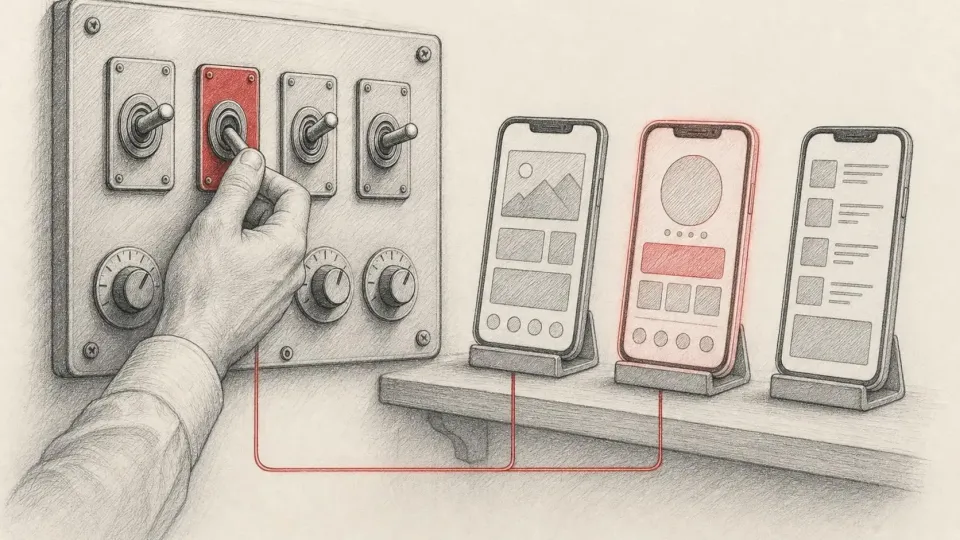
How to Validate a Mobile App Idea Before Development Begins

How to Validate a Mobile App Idea Before Development Begins

The most expensive mobile product mistake is not a technical bug. It is spending months building a feature that does not solve an important problem. Validating an idea before writing code helps separate real demand from a team’s assumption, and it costs a fraction of reworking a finished app.

This article describes the process we go through with clients during discovery: from framing the problem to a minimum experiment with a success criterion defined in advance. It does not guarantee success, but it shows honestly where the development budget should go.

Start with a problem, not features

Describe the problem in one sentence: who has it, when it appears, and how people solve it today. For example: “Owners of small coffee shops manually compile weekly supplier orders in a messenger and regularly get quantities wrong.” That sentence can be tested; “people need a convenient business app” cannot.

Then speak with people from the audience and ask about the last real instance, not a hypothetical “would you use this?” Behavior is usually more reliable than intent: almost everyone will agree an idea is interesting, but only some will remember the last time they faced the problem and how much time or money it cost. Rob Fitzpatrick describes this approach in detail in The Mom Test.

What to validate: four dimensions

DimensionInterview questionStrong signalWeak signal
Frequency and impact“When did this last happen? What happened next?”Weekly, with concrete loss of time or money“Sometimes,” with no example
Current alternatives“How do you solve it now? What does it cost?”Spreadsheets, manual work, paid workarounds“I don’t, but it would be nice”
Moment of habit change“What would have to happen for you to try something new?”A specific event or triggerGeneral agreement with no conditions
User language“How would you describe this to a colleague?”Repeated words across respondentsTerms the team invented

In our experience, 8–12 interviews with one clearly defined group are usually enough for answers to start repeating. If the picture is still chaotic after 12 conversations, the segment is most often defined too broadly.

A few practical interview rules: 30–45 minutes, one interviewer and one note-taker, recording only with the respondent’s consent. Recruit where the audience already discusses the problem: professional communities, topic chats, customers of an adjacent service. Right after each conversation, write down three quotes and one concrete case — a day later the details fade and your notes will contain only your interpretations.

What the YouTube Go story teaches

The YouTube Go story, written up by Google Design, shows why field research matters. The work began in 2014 with interviews in India, later expanded to Indonesia and Nigeria, and lasted about two years.

The team did not assume users simply wanted “lighter video.” An early concept with low-quality video — key frames with audio — was rejected by participants: they wanted a decent picture even with limited data. Instead, the real problem turned out to be opaque costs: people could unknowingly burn through a 100 MB data pack in one sitting. So the app showed a preview of key frames and the file size before streaming or downloading — for example 2, 5, or 12 MB depending on quality.

The key lesson: the right problem (“I don’t know how much data I will use”) was different from the obvious assumption (“I need worse but lighter video”). That kind of discovery is exactly what pre-development validation is for.

A minimum experiment, step by step

Before building an app, you can test a one-page description, a prototype of the core journey, a manually delivered service, or a waitlist. Here is the sequence we recommend:

  1. Write the hypothesis. “If [audience] gets [solution], they will [action], because [reason].”
  2. Define the success criterion before starting. For example: at least 40 waitlist sign-ups from the target segment in two weeks, or 7 of 10 prototype test participants completing the core journey without hints.
  3. Choose the cheapest format that answers this specific hypothesis (see the table below).
  4. Run it and do not change conditions mid-test, or the result becomes impossible to interpret.
  5. Record the decision: continue, change the hypothesis, or stop. No decision is the worst outcome.
FormatWhat it testsTypical timeline (studio experience)
Landing page + waitlistInterest in the promise and the language of value1–2 weeks
Clickable Figma prototypeClarity of the core journey1–2 weeks, 5–8 test sessions
Concierge / manual serviceWhether people actually use the outcome and come back2–4 weeks
Design sprintA fast team decision on a contested question, tested with users5 days

The design sprint format, in which a team moves from a problem to a tested prototype in five days, was described by Google Ventures in The Design Sprint.

Common validation mistakes

  • Asking about the future. “Would you download an app like this?” almost always yields an optimistic, useless answer.
  • Talking to friends and colleagues. They want to be supportive, not to give an honest signal.
  • Presenting the solution in the first half of the interview. After a demo, people discuss your idea rather than their problem.
  • Not defining the success criterion in advance. Then any result can be read as “broadly positive.”
  • Counting likes and views instead of actions that cost people time, contact details, or money.
  • Testing everything at once. One experiment, one hypothesis.

Checklist before development starts

  1. The problem is stated in one sentence and confirmed by real instances.
  2. At least 8 interviews were held with one clearly defined group.
  3. Current alternatives and their cost to the user are known.
  4. The words the audience uses for the need are collected and used in the prototype.
  5. A minimum experiment was run against a predefined criterion.
  6. There is a written decision: what we build first and why.
  7. There is a first estimate of how the product will pay off — see our article on whether a mobile app pays off.

A strong validation does not guarantee success. It reduces uncertainty and shows which problem deserves attention first. That saves team time and makes the eventual MVP much more precise. For the wider market context, see our overview of the key mobile market numbers for 2025.

Sources:Google Design: Making YouTube Go; Rob Fitzpatrick: The Mom Test; GV: The Design Sprint.

Journal

Ideas and products