

Mosmoxmosmox
Get in touch
← Back to pricing & terms

E-COMMERCE MOBILE APP

Online shop app

We turn an online shop into a fast mobile sales channel with a personal experience, push communication, and easy repeat purchases.

MOBILE STOREFRONT AND SHOPPING

Catalogue, personalised offers, cart, payment, and delivery status — in one clear mobile journey.

Discuss your shop
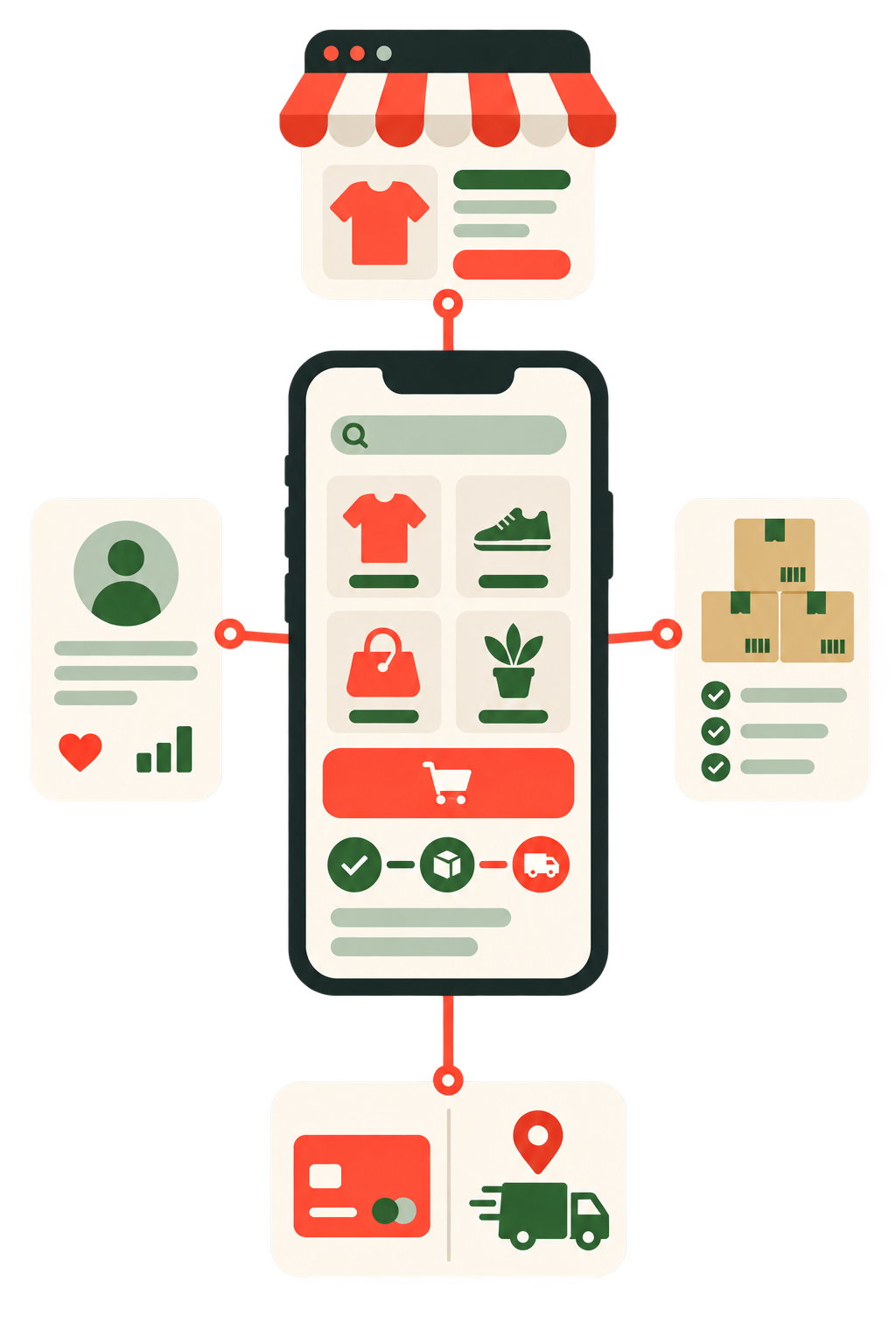
Illustration of a mobile online shop with products, cart, payment, and delivery

What kind of product is this

Your online shop in the customer’s smartphone.

A mobile e-commerce app is a separate sales channel that brings your catalogue, purchases, and customer communication into a convenient personal experience.

Users can quickly find a product, receive a personalised offer, place and pay for an order, and see delivery status without unnecessary page changes.

Who it is for

For businesses that want to grow with their customers.

This product suits retail brands, D2C companies, store networks, and manufacturers with their own online sales.

The app helps increase repeat purchases, bring customers back through push notifications, and build long-term relationships with the audience.

Functional blocks

The app is built around your sales journey.

We define the feature set after analysing the business, catalogue, logistics, and existing systems. Below are the main sections the app may include.

01 / Catalogue

Products and search

Categories, filters, sorting, search, product variants, specifications, photos, and video.

02 / Sales

Cart and orders

Cart, promo codes, bonuses, repeat purchases, delivery choice, and checkout.

03 / Payments

Secure checkout

Online payments, cash on delivery, saved payment methods, receipts, and clear payment status.

04 / Account

Personal experience

Profile, addresses, favourites, order history, statuses, returns, and personalised offers.

05 / Communication

Push and notifications

Cart reminders, new arrivals, promotions, order status updates, and segmented campaigns.

06 / Analytics

Data for growth

Events, sales funnel, conversions, repeat purchases, campaigns, and key product metrics.

Integration with your infrastructure

The app works with the systems your business already uses.

We connect the mobile channel to your existing website, CRM, or ERP so catalogues, inventory, prices, and orders stay in sync without duplicate team work.

01

Analyse the systems

We study the website, API, data exchange, pricing rules, inventory, payments, and delivery.

02

Design the data exchange

We define which data moves between the app and your system and how errors are handled.

03

Test the scenarios

We check product sync, checkout, payments, order statuses, and performance under load.

If the website or required system does not exist yet

We can build an online shop website from scratch, create a backend and API for the mobile app, or connect it to your CRM or ERP — for example, to sync products, customers, orders, inventory, and financial data.

Mobile online shop connected to a website, CRM, and ERP system

Platforms

iOS, Android, Web / PWA

Estimated timeline

4–12 weeks

Estimated budget

approximately $2,000–$10,000

The range is refined after the brief.

What may be included

Functionality for your business scenario.

The feature set is not a fixed template. We define priorities together and assemble an MVP worth launching.

Product catalogue and search
Cart, promo codes, and payments
Personal account and order status
Push notifications and analytics

How we move forward

From the first conversation to release.

01

Discovery

Goals, users, competitors, and a precise brief.

02

Design

UX flows, prototype, and visual system.

03

Build

Development, integrations, QA, and release preparation.

04

Grow

Publishing, analytics, support, and growth.

Other scenarios

Another direction may be a better fit.

Tell us what needs to be created.

An accurate estimate and timeline come after a conversation, challenge analysis, and an agreed brief.

Start a conversation

Journal

Ideas and products

All posts
How to Tell If Your Mobile App Pays Off

How to Tell If Your Mobile App Pays Off

A mobile app can have many installs and still fail to deliver the return a business expects. To understand whether a product pays off, look beyond a single impressive number and follow the whole user journey: from the first open to repeat purchase and long-term use.

What “paying off” really means

Payback does not always mean instant revenue after launch. For some products, it means direct income from purchases or subscriptions. For others, it means more repeat orders, lower service costs, more frequent visits, or higher customer value. Start by defining the business outcome and the period you will use to evaluate it.

Installs: an early signal, not the result

Install volume shows how well reach, advertising, and the app store page are working. An install alone does not create value. Also track acquisition source, first launch rate, registration, and cost per install. If people install the app but never reach a useful first action, the issue may be positioning or onboarding.

Registration and activation

Registration is one step closer to value, but activation should be the key milestone: the moment when a person gets a real result. For a service, it may be the first order; for a finance product, a funded account; for a B2B tool, the first task created. Compare install-to-registration and registration-to-activation conversion.

Retention: do users come back

Retention shows what share of people return after a day, a week, or a month. Cohorts help separate a temporary spike from a lasting habit. Look beyond the average and compare channels, segments, and product versions. If retention drops after the first week, review the value of the repeat scenario, reminders, and overall experience.

Repeat purchases and revenue

For a commercial app, track repeat purchase rate, average order value, paid conversion, and revenue per active user. Separate new customers from returning customers. A repeat purchase often reveals real product value more clearly than a one-time transaction.

Acquisition cost and customer value

CAC is the cost of acquiring one customer. LTV is the expected value of that customer over the full relationship. A practical rule is that LTV should exceed CAC by enough to cover operations, risk, and product development. Calculate these metrics by channel and cohort so an expensive acquisition source cannot hide inside an overall average.

How to build a useful measurement system

Start with one primary metric tied to the business outcome and three or four supporting metrics. For example: activation, day-30 retention, repeat purchase, and revenue per user. Define the events, data sources, and review cadence. Metrics should support decisions: what to change in the product, which channel to scale, and where another experiment is needed.

Conclusion

You can see whether a mobile app pays off when marketing spend, user behavior, and revenue are connected in one clear model. Installs show scale, registration and activation show first value, retention shows habit strength, repeat purchases show the quality of the offer, and LTV-to-CAC shows the economics of growth.